
VÖBAM - Din källa till den äldre bild- och kartvärlden. - Tel: 08-102121 - Epost: info@vobam.se
Biografier.

Bonne, Rigobert.

1727–1795
One of the most important cartographers of the late 18th century.
In 1773 Bonne succeeded Jacques Nicolas Bellin as Royal Cartographer to France in the office of the Hydrographer at the Depôt de la Marine. Working in his official capacity, Bonne compiled some of the most detailed and accurate maps of the period. Bonne’s work represents an important step in the evolution of the cartographic ideology away from the decorative work of the 17th and early 18th century towards a more detail oriented and practical aesthetic. With regard to the rendering of terrain Bonne maps bear many stylistic similarities to those of his predecessor, Bellin. However, Bonne maps generally abandon such common 18th century decorative features such as hand coloring, elaborate decorative cartouches, and compass roses.
While mostly focusing on costal regions, the work of Bonne is highly regarded for its detail, historical importance, and overall aesthetic appeal.
Bland arbeten.
'Partie Occidentale du Canada'


HAGELSTAM, OTTO JULIUS.

1784-1870. Född i Nagu socken, Åbo och Björneborgs län, Finland, död i Stockholm.
Finsk-svensk officer och kartograf. Son till kaptenen Gabriel August Hagelberg och Anna Lovisa Qvick; u.ä.-dotter till fältmarskalken greve Augustin Ehrensvärd. Hagelstam utmärkte sig som officer i finska kriget och i sjömätningsarbeten. 1810 utnämnd till kapten i den nyupprättade Sjömätningskåren, och avancerade senare till överste. 1814 var han den svenska regeringens kommissionär i Köpenhamn vid överlåtelsen av norska kartor och andra arkivalier rörande Norge. Initiativtagare till Väddö kanal i Roslagen. Hagelstam utarbetade ett flertal kartor över Sverige och Norge, för detta arbete adlad 1818. Som riksdagsman var han en ivrig nykterhetsförespråkare och medverkade till att brännvinsskatten lades om 1855 och att husbehovsbränningen förbjöds 1860. Medlem av Krigsvetenskapsakademin och utgivare av flera militära skrifter om Sveriges kust- och havsförsvar. Hagelstam var gift med Eva Fredrika Burenstam (1791-1877), genom vilken han ärvde Stjärnsunds slott i Askersunds landsförsamling, som han 1823 sålde till k
...
Bland arbeten.
Ska artikeln hit?


Andrié, Jean-Henri


Var ansvarig för de ca 4200 geografiska artiklarna i Yverdon-encyclopedin.
Bland arbeten.
Encyclopédie ou dictionnaire universel raisonné des connaissances humaines.
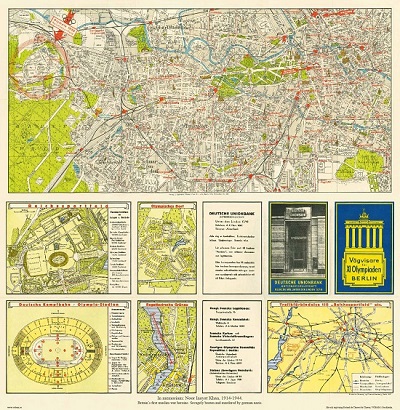


Vägvisare för XI Olympiaden i Berlin - 1936


Kronärtskocka - Olof Rudbeck.


Sök efter biografi:

Du sökte på: 10477

Klicka på valfri bokstav för att återgå till hela listan.  

A  B  C  D  E  F  G  H  I  J  K  L  M  N  O  P  Q  R  S  T  U  V  W  X  Y  Z  Å  Ä  Ö

Dudley Chase, Ernest.

Pictorial maps - maps with vignette illustrations on top of the geographical content - go back practically to the known beginning of cartographic history: Petroglyph maps dating from the Neolithic sometimes are found combining geographic features with representations of animals, people or dwellings.

Vignette insets or overlays are also found throughout the period of printed maps. But maps richly overlaid with small pictures are more commonly found from the 19th century onwards. (A notable exception is the Carta Marina of Olaus Magnus, published in Venice in 1539, which presents a depiction of Scandinavia with more than 100 small woodcut illustrations of animals, real and imagined, and of people pursuing all kinds of activities, such as hunting, fishing, skiing, etc.)

Ernest Dudley Chase was an exceptional creator of pictorial maps. Though he worked primarily as a graphic artist and businessman in the greeting card industry, Chase also designed, drew, and self-published more than 50 pictorial maps, each densely packed with detailed vignettes reflecting the areas portrayed. In this map of the United States, each state's capitol building is shown, as well as many other vignettes of buildings, famous sights (e.g. Niagra Falls, Hoover Dam) and pictures of people pursuing outdoor activities (fishing, horseback riding, panning for gold, etc.) appropriate to the particular region. In addition to the vignettes in the body of the map, there are 32 vignettes drawn in the blank areas outside the country's borders, mostly showing famous buildings, and 4 vignettes in the corners showing symbols of the country's natural bounty: a bull's head, a longhorn sheep's head, a sheaf of wheat, and a branch from a cotton plant.

Most of Chase's maps display a sense of humor. Though this map is mostly serious and respectful in its portrayal of the United States, the humor creeps in from time to time, such as the small collection of broken hearts outside of Reno, Nevada.

Since Chase published and sold his maps on his own, many of them bear his manuscript signature, as can be seen in the bottom margin, at the left, in this example.

In March, 2003 the Harvard Map Collection presented an exhibit of the pictorial maps of Ernest Dudley Chase, curated by Joseph Garver. The Boston Map Society met on the opening night, and the members were given a guided tour of the exhibit.

To see more online images of Chase's maps, click here to go to the Harvard Library online catalogue (Hollis), enter 'Ernest Dudley Chase' in the 'Search For' field, and click 'Search'. Follow the 'Internet Links' to see images for the individual maps.
Bland arbeten:
A Pictorial Map of North America 1945.
A Pictorial Map of South America 1942.

Tillbaka till början.