
1774-1836.
Appointed engineer at the Survey Office in 1801, but was not eligible for salary until a permanent position became vacant. In 1809 was commissioned lieutenant at the marine measurement corps and made supervisor at the Sea Charts Office. Known for his skill and great modesty.
Sveriges sjökartor – A. Hedin.
Engelsk bokhandel- och förlagsfirma grundlagd i London 1724 av Thomas Longman (se denne). Bland förlagets författare under den första tiden finner vi David Hume - en senare innehavare av Thomas Norton Longman (1771-1842). Under hans tid möter vi Walter Scott, Thomas Moore m.fl. Förlagets produktion spände även över kartor, men de verkar ha varit i mer begränsad skala. Under årens lopp har firman övertagit flera andra förlag. Under firmanamnet Longmans, Green & Co. driver det idag en världsomspännande verksamhet med filialer över hela det brittiska imperiet.
Dict. nat. biogr.
Bland arbeten.
Geografia di M. Livio Sanuto distinta in XII libri. Venice: Damiano Zenaro, 1588.
The first printed atlas of Africa. Sannuto’s Geographia was intended as a compendium of world geography, but the project was curtailed by his death. Only the first part, devoted to Africa, was ever published, and that posthumously. Skelton describes the Geographia as a “methodical and precisely documented description of the geography of Africa” and notes the “critical sense” exercised in the compilation of the maps, engraved by Sanuto’s brother Giulio.
It is unfortunate that the work was left incomplete, as Skelton suggests it would have been “among the masterpieces of Renaissance geography”; the fact it was incomplete may help explain its rarity on the market today.
Skelton, Bibliographical note to the facsimile of Livio Sanuto’s Geographia dell Africa.
Sotheby's. Mendelssohn (1957) II, p. 269; Nordenskiöld Collection 2, 277; Skelton, Bibliographical note to the facsimile of Livio Sanuto’s Geographia dell Africa.3 5000-7000
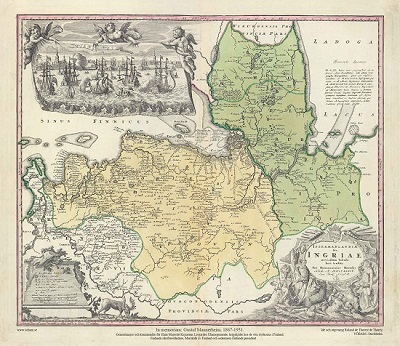
Ingermanlandiae – Homanns Erben 1734

Storskarv - Olof Rudbeck d.y.
